
Stability and shelf-life testing is a sequence, and treating it as a sequence is what keeps a travel retail launch on schedule. The order runs from a fixed pack list, to a written test scope, to filled units from a production-representative batch, to controlled storage, to results that feed the safety assessment and the artwork, and finally to a retained reference that governs every reorder. Projects that slip almost always skipped one of those steps or ran two of them at the same time. The sequence below is the version that fits a listing date, with the decision point at each stage named.
Key takeaways
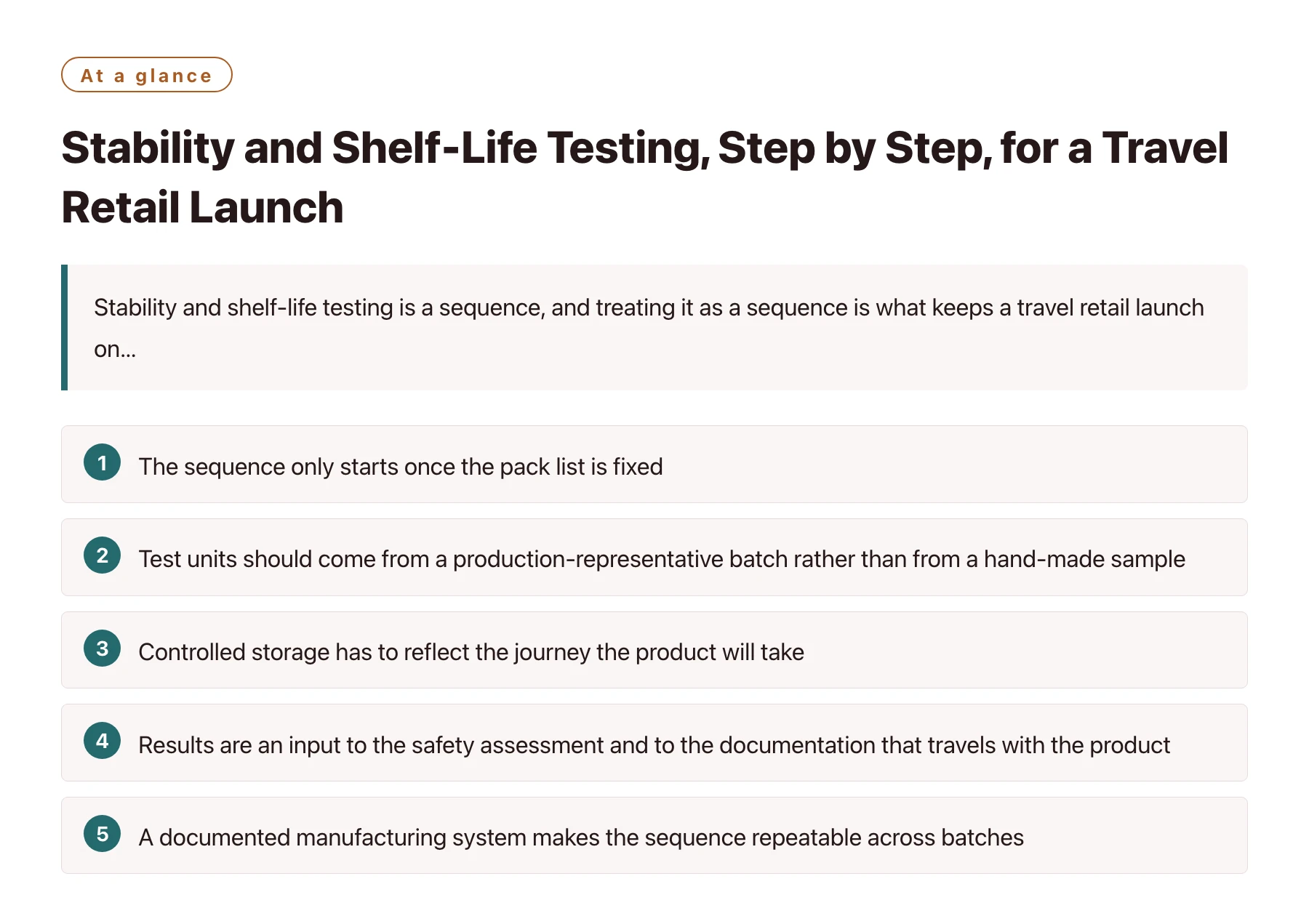
- The sequence only starts once the pack list is fixed, because every later step is defined by which materials the juice will touch.
- Test units should come from a production-representative batch rather than from a hand-made sample, or the results describe something the factory will not reproduce.
- Controlled storage has to reflect the journey the product will take, including transit temperature swings and a lit retail fixture, not only a laboratory shelf.
- Results are an input to the safety assessment and to the documentation that travels with the product, so the record has to be usable by someone who was not in the room [1].
- A documented manufacturing system makes the sequence repeatable across batches, which is what a multi-market listing ultimately depends on [2].
- The sequence ends with a sealed reference from the first bulk batch, without which a later complaint or reorder has nothing objective to be measured against.
Manufacturers describe testing in different ways, and the differences are usually about where the work sits rather than about what is done. Some treat it as a development activity that closes the formula, others as a release activity that qualifies a batch. For a launch, both readings matter, and the sequence below assumes the same project has to satisfy development questions early and release questions later.
The value of running it as a sequence is that each step produces something the next step needs. Skipping ahead is what produces the expensive version of the work: re-testing because the pack changed, or re-labelling because the claim outran the evidence.
Here is the order, with the decision that closes each stage.
The sequence, from pack list to retained reference
- Step 1: Fix the pack listName every combination of juice, bottle or vial, closure, pump and decoration that will be sold. Group the combinations that genuinely share materials and treat the rest separately. Nothing downstream can be scoped until this list exists.
- Step 2: Fix the claim and the market listDecide what shelf-life and period-after-opening statements the packaging will carry and in which markets the unit will be offered. The stricter market defines the documentation burden, so the market list belongs here rather than at the artwork stage.
- Step 3: Write the test scope matrixFor each combination, record the conditions, the duration and the property being observed. The output is a table that a laboratory, an internal team or a third party can price and execute without interpretation.
- Step 4: Produce production-representative unitsFill the test units from a batch made the way the product will actually be made, in the actual pack. Units that are hand-filled or hand-labelled introduce a variable the study is supposed to be measuring.
- Step 5: Run storage and observationHold the units under the agreed conditions, including cycling and light exposure where the channel requires them, and record observations on a schedule rather than at the end. Early observations are what allow a formula to be adjusted before a batch is lost.
- Step 6: Fold results into documentationTransfer the results into the safety assessment, the product information file and the artwork inputs, and keep the raw data with enough context that a reviewer can follow the reasoning. A result without its conditions is not evidence.
- Step 7: Retain the referenceSeal a retained unit from the first bulk batch, link it to the batch record, and state how long it will be held. This is the artefact that turns the whole sequence into something a reorder can be judged against.
Where the sequence usually slips
The most common failure is not a missing test but a mis-ordered one. A brief that locks the artwork before the market list is final will usually need a second print run. A project that commissions the full programme before the decoration vendor is chosen will usually pay for a repeat when the lacquer changes.
The second pattern is over-testing at the wrong moment. Running a long study on a formula that is still being refined consumes capacity and calendar for a result that will be discarded. The efficient approach is a short accelerated round to eliminate weak candidates, followed by the full scope on the one that will actually be sold.
Why the sample table is a poor place to start
Sample tables are built for evaluation, not for stability. A sample may be hand-weighed, filled into a stock bottle and stored in a drawer. The question a stability study answers is how the product behaves in the pack that will be sold, from a batch made the way it will be made. Starting from the sample table is comfortable because that is where the scent was approved, but it answers the wrong question, and the gap between the stages of perfume production and a sampling round is exactly where those differences live.
What buyers can reasonably ask for at each stage
At step three, ask for the scope matrix in writing. At step five, ask for the observation schedule and who holds the raw data. At step seven, ask how long the retained reference is kept and what triggers a comparison against it. None of these requests require technical training, and each one produces a document that is useful long after the launch.
What to hand over when the sequence ends
The sequence should end with a small pack of documents rather than with a verbal assurance: the scope matrix, the observation records, the reports, the retained reference details, and the labelling inputs derived from the results. Together these make the product portable, which matters when a retailer, an importer or a new market asks a question two years after the launch.
It is worth checking early whether a manufacturer treats these handovers as routine. Companies that publish their development and manufacturing scope, as Xuelei official site does, generally have a standing answer for what a customer receives at the end of a project, and asking for it before the order is placed is a normal procurement question rather than a challenge.
One caution on interpretation: a document pack demonstrates that a process exists. It does not transfer responsibility for the claim. The brand remains responsible for what its packaging asserts, which is why step two belongs to the brand and not to the supplier.
If the launch schedule is tight, compress the sequence by running steps in parallel only where they do not depend on each other. Steps one and two can run together. Steps three and four can overlap with decoration decisions, provided the decoration is frozen before the units are filled. What cannot be compressed is the dependency between the pack list and everything after it. Buyers who want a worked example of a single partner handling compounding, filling and assembly in sequence can look at how fragrance manufacturing under one roof is organised and compare it against their own schedule.
A note on documentation culture
Testing lives inside a wider documentation culture, and the quality of that culture is what determines whether the sequence survives a staff change or a busy quarter. Industry guidance on good manufacturing practice for cosmetics describes record keeping as part of the system rather than as an administrative afterthought, which is a fair description of why some factories can answer a stability question in an hour and others need a week [3].
For a buyer, the practical implication is simple. Ask for a document that was produced for another project, with the commercially sensitive parts removed. What arrives, and how quickly, says more about the system than any description of it.
Sources
- EU Scientific Committee on Consumer Safety (SCCS) —— The EU scientific committee that issues opinions on the safety of cosmetic ingredients, including fragrance allergens and their labelling thresholds.
- ISO 22716:2007 — Cosmetics, Good Manufacturing Practices (GMP) —— The international good manufacturing practice standard for cosmetic products, covering production, control, storage and shipment, including the documentation expected of a manufacturing site.
- Cosmetics Europe —— The European trade association for the cosmetics and personal care industry, publishing guidance, positions and market information.
Frequently asked questions
Where does stability testing sit in a fragrance development timeline?
Partly in development and partly after it. A short accelerated round is most useful while candidates are still being compared, because it removes weak options early. The full scope, including the pack combinations that will be sold, belongs after the formula and pack are frozen and a production-representative batch exists.
Can testing start before the packaging is chosen?
Some of it can. Formula-level screening can begin early, since it does not depend on the pack. Anything described as compatibility testing cannot, because compatibility is a property of the juice and the pack together. Starting compatibility work before the pack is fixed usually means testing a combination that will not be sold.
How many units are needed for a stability study?
It depends on the number of combinations and observation points, and there is always a case for spares. The important principle is that the units are drawn from a batch made the way production will make it and filled into the real pack, since a study built on hand-filled samples measures a different product.
What does a retained reference actually protect?
It protects both parties. If a customer reports a difference, the reference allows an objective comparison rather than a debate about memory. If a reorder is produced months later, the reference is the standard the new batch is measured against, along with its batch record.
Does travel retail require different testing from a domestic launch?
The work is similar, but the exposure assumptions differ. Products travel further, sit in transit warehouses, and are displayed under strong light, often in more than one market with different labelling expectations. The sequence does not change; the conditions and the documentation scope do.